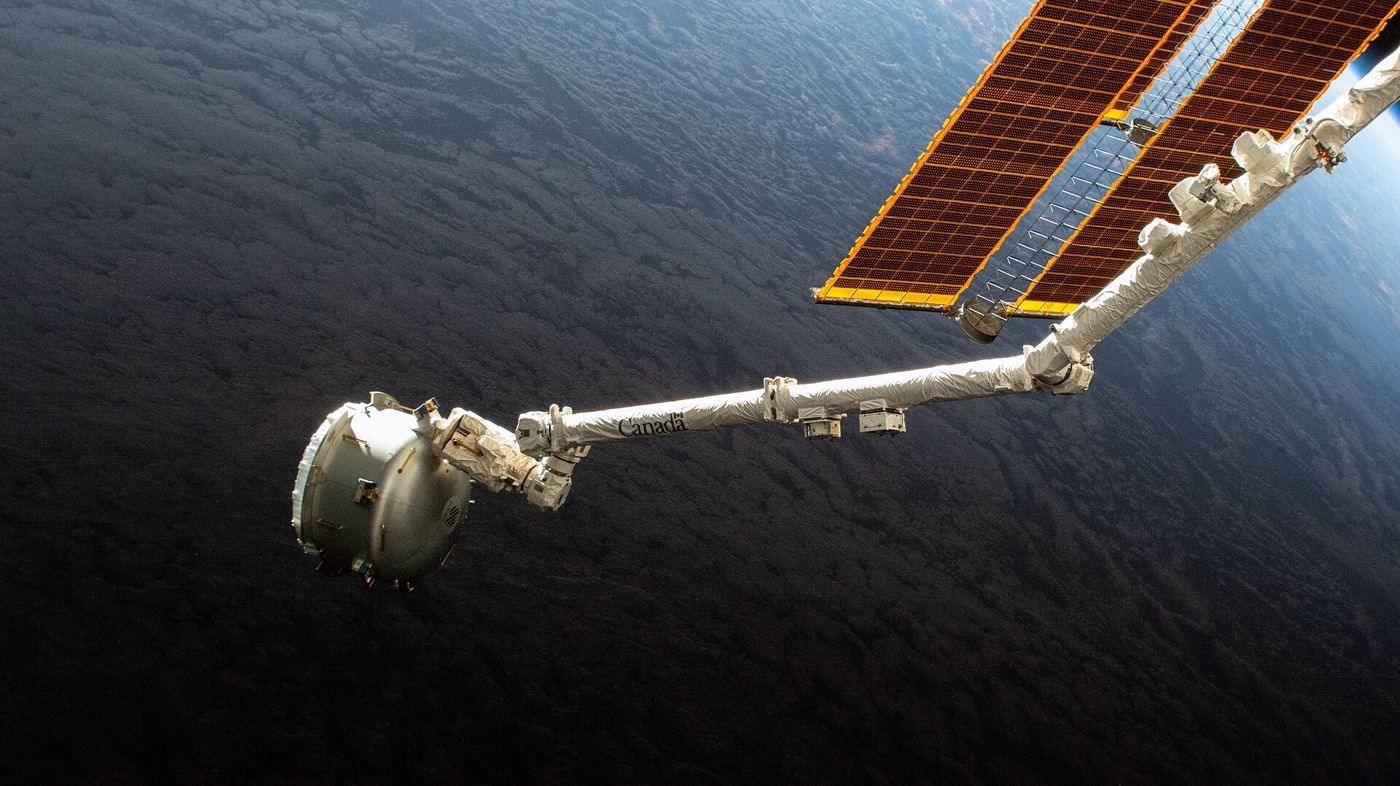
A robot built by researchers at the California Institute of Technology has assembled part of a structure in space without help from astronauts, a first in the history of spaceflight. The achievement was announced on 5 November 2026 after six months in orbit. The robot, called ASTRA, is part of the DARPA Novel Orbital and Moon Manufacturing, Materials, and Mass-efficient Design programme, known as NOM4D. It uses an automated arm to pick up composite fibre tubes and aluminium joints from nearby dispensers and join them into repeating sections, called bays, of a perimeter truss. ASTRA launched on 30 March 2026 aboard a SpaceX Transporter-16 rideshare from Vandenberg Space Force Base, travelling on the Momentus Vigoride 7 vehicle. Two bays of its 1.4-metre reflector antenna were prebuilt, and the robot built a third bay in orbit.
What the Evidence Shows
Building large structures in space has always been limited by the size of the rocket that carries them. Telescopes, antennas and solar arrays must fold up to fit inside a fairing, which caps how large they can be. Assembling them in orbit from small parts breaks that limit: raw materials can be packed tightly for launch and built into structures hundreds of metres or even kilometres wide. The demonstration was far from smooth, with engineers able to contact the payload only in a few 15-minute windows each day, and time ran out before the full 11-bay antenna could be finished. The mission ends in December, but the team says the concept is proven and now needs to be simplified. A second NOM4D project from the University of Illinois will test on-orbit manufacturing aboard the International Space Station before the end of the year. Reporting and analysis from sources such as Wired track the same developments, and specialists following the ASTRA robot say the direction is now consistent across independent lines of evidence.
The Wider Context
The wider context is an industry learning to ship capability and restraint together. Products built around the ASTRA robot now launch with safety evaluations, usage data and rollback plans as standard, because enterprise buyers and regulators ask for them in the first meeting. Companies that treated those questions as friction are discovering they have become the purchase criteria.
What Happens Next
What happens next for the ASTRA robot depends less on another breakthrough than on the unglamorous work of reliability, pricing and support. The buyers evaluating it now are not enthusiasts; they are operators with budgets and auditors, and their checklists will decide the timeline. On the evidence of the current pilots, the technology has earned the right to be judged by them. You can follow related developments in our coverage of technology.
None of this will be settled by a single announcement, study or product launch. The pattern to watch is accumulation: independent confirmations, honest reporting of failures and steady improvement in the underlying numbers. Readers who follow those signals, rather than the loudest claim of the week, will understand this subject better than most of the commentary surrounding it suggests is possible.