
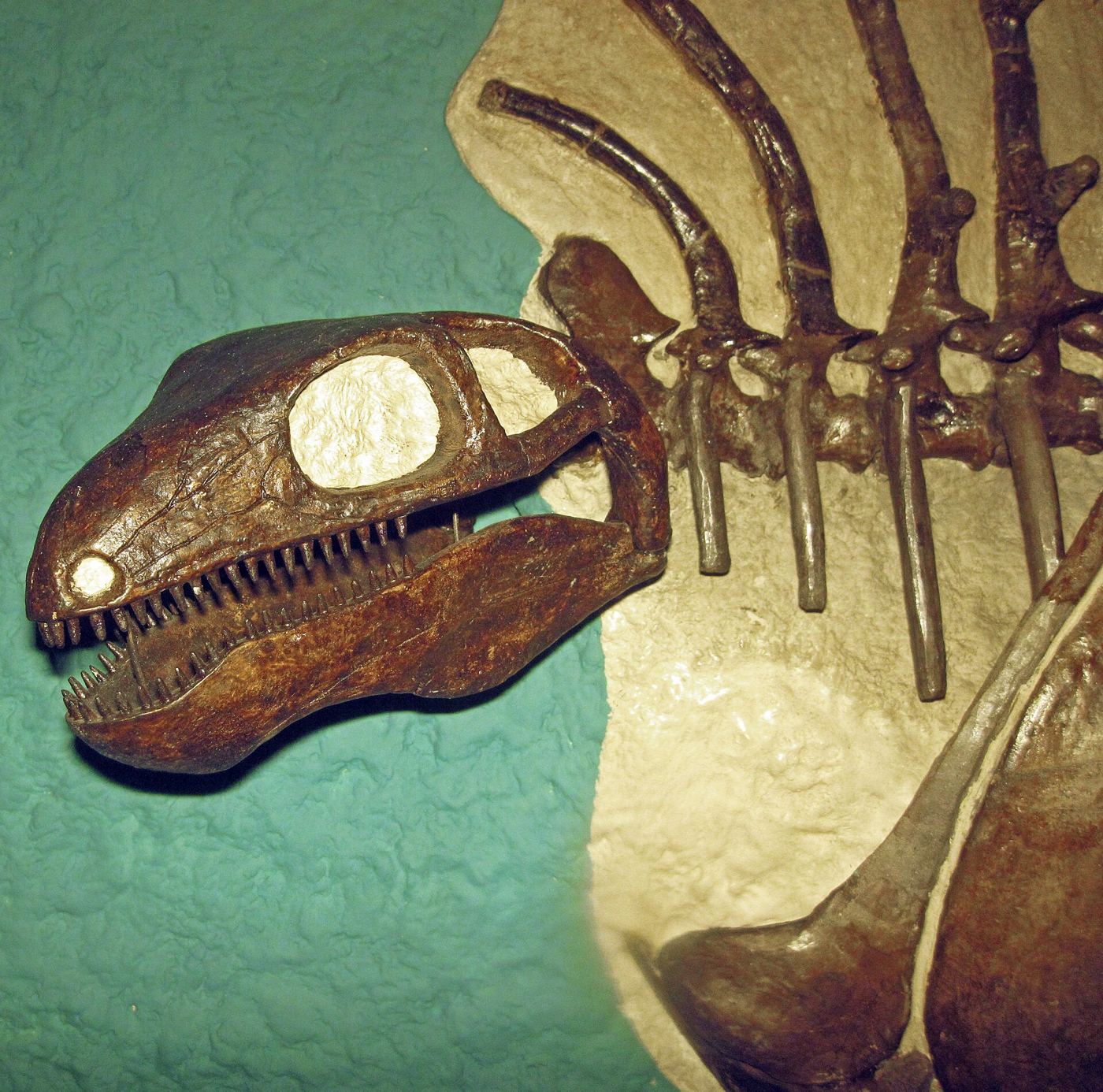
Neutron scans have revealed a new species of tiny horned reptile that lived in Wyoming 156 million years ago, a creature its discoverers describe as a small prehistoric dragon. The fossil was found in a quarry in 2022 by an excavation team from the Aathal Dinosaur Museum in Switzerland, and researchers reported the discovery in November 2026 in the journal Royal Society Open Science. At first nobody could classify the fossil, which was a piece of torso hidden inside rock, and the team wondered whether it was a baby dinosaur or a prehistoric snake. Neutron imaging at the Paul Scherrer Institute in Switzerland revealed what lay inside, including pelvic bones, parts of a hind leg and a tiny skull with an almost completely preserved braincase. The animal was about 45 centimetres long and had two dragon-like horns on the back of its head.
What the Evidence Shows
The reptile was named Meilynodraco amonamarthi, and it belongs to a long-extinct group called choristoderes, whose place on the evolutionary tree remains a mystery. The international team was led by Pavel Trtik at the Paul Scherrer Institute and Torsten Scheyer, a palaeontologist at the University of Zurich. The researchers had to combine tens of thousands of cross-sectional images from neutron and X-ray tomography before the little reptile began to take shape. It is the most complete early-branching representative of the choristoderes known to date, and the oldest record of the group in North America. The name honours both the dragon-like horns and the world of fantasy literature, and the museum team says the find shows how much history can still hide inside an unremarkable-looking rock. Reporting and analysis from sources such as National Science Foundation track the same developments, and specialists following the tiny horned reptile Meilynodraco say the direction is now consistent across independent lines of evidence.
The Wider Context
The wider context is a research landscape in which replication and open data now decide reputations. Findings connected to the tiny horned reptile Meilynodraco are being checked by independent groups with shared datasets, and the teams involved publish their methods in full so rivals can test every step. That discipline is slower than a headline cycle, but it is why results in this area increasingly survive first contact with scrutiny.
What Happens Next
What happens next in the story of the tiny horned reptile Meilynodraco will be decided by follow-up work already under way: larger samples, longer observation and instruments that have not yet come online. The researchers involved are unusually united on one point, that the current results justify the next investment of time and money. Readers will not have to wait long for the first tests of that claim. You can follow related developments in our coverage of science.
There is a practical lesson in all of this for readers deciding what to do today. Start with the verified facts, be wary of anyone promising certainty, and prefer reversible steps while the evidence is still developing. Circumstances differ by country, income and personal situation, so general guidance should always be weighed against your own context before you act on it in any significant or lasting way.